


(Organization for Marine Conservation, Awareness and Research)
PALK BAY CENTER
Seagrass Ecosystems of Palk Bay
Discover Palk Bay’s seagrass meadows through OMCAR’s field research, mapping, biodegradable restoration and community monitoring.
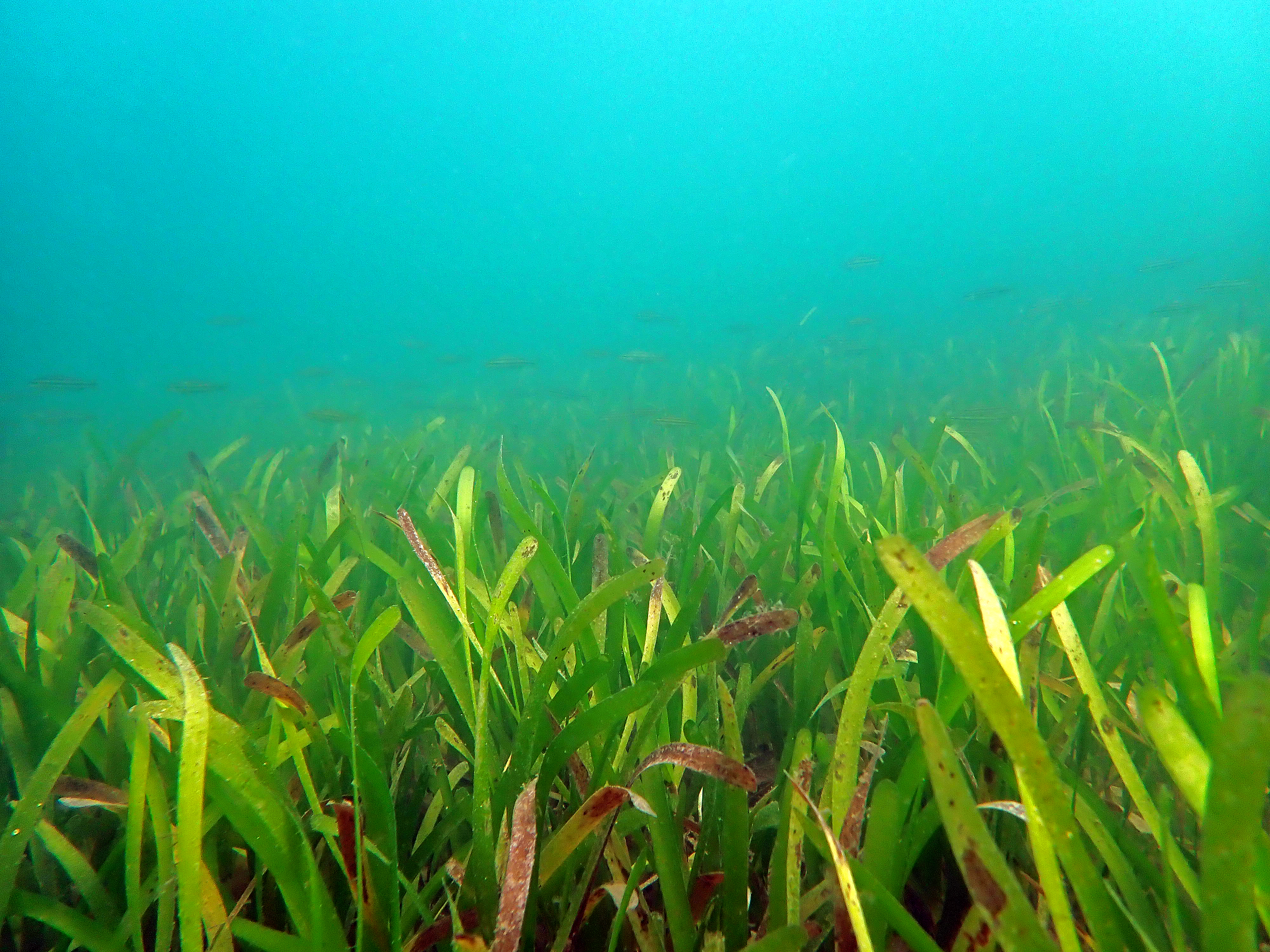
Living meadows beneath Palk Bay
Seagrasses are marine flowering plants that form underwater meadows in shallow coastal waters. Their leaves, roots and rhizomes create feeding, nursery and shelter habitat, stabilise sediment and store carbon in plants and seabed soils. In Palk Bay, these meadows connect biodiversity, fisheries and the long-term health of coastal communities.
A field record from northern Palk Bay
OMCAR’s early work examined seagrass distribution and seasonal change at Keezhathottam, Velivayal and Manora. Field observations in 2006 recorded cover, species composition, canopy height, shoot density, biomass and environmental conditions across post-monsoon, summer, pre-monsoon and monsoon periods. The study documented Halodule pinifolia, Cymodocea serrulata and Syringodium isoetifolium and showed why survey dates and seasonal freshwater influence matter when interpreting change.
Map the meadow, then verify it underwater
OMCAR combines field observations with acoustic mapping, georeferenced underwater video and drone photogrammetry. Each method answers a different question: acoustic surveys examine submerged meadow extent, underwater records identify plants and seabed condition, and suitable aerial imagery helps document shallow-water patterns. Reliable interpretation keeps methods, dates, depth, tide and ground observations with every map.
Explore seagrass acoustic surveys · Explore drone photogrammetry
Restore degraded patches with biodegradable materials
OMCAR’s restoration work developed from mapping and field experimentation. A 2017 comparison tested PVC frames, bamboo frames and coconut-coir nets for sprig transplantation. The published study found that recovering PVC frames could damage rhizomes, while biodegradable bamboo and coir methods were more suitable for low-cost, community-based restoration. Current public guidance therefore focuses on bamboo, coir and jute rather than plastic structures.
Protection and monitoring are part of restoration
Transplanting alone cannot secure recovery. Site selection should favour suitable degraded patches within or near existing meadows, followed by protection from damaging disturbance and repeat monitoring. OMCAR records plant condition, meadow structure, water and sediment conditions, grazing signs, physical damage and maintenance needs so that management decisions remain connected to evidence.
See the seagrass monitoring framework
Research and community stewardship
Fishers and local residents contribute practical knowledge, restoration preparation, field deployment, protection and monitoring. Scientific publications and field records keep that experience available for learning while distinguishing measured results from proposals or expectations.
Selected OMCAR publications
- Comparison of seagrass restoration methods adopted in Palk Bay, India (2020)
- Fish assemblages associated with natural and artificial habitats in Palk Bay (2019)
- Seagrasses of Northern Palk Bay, Seagrass-Watch Issue 38 (2009)